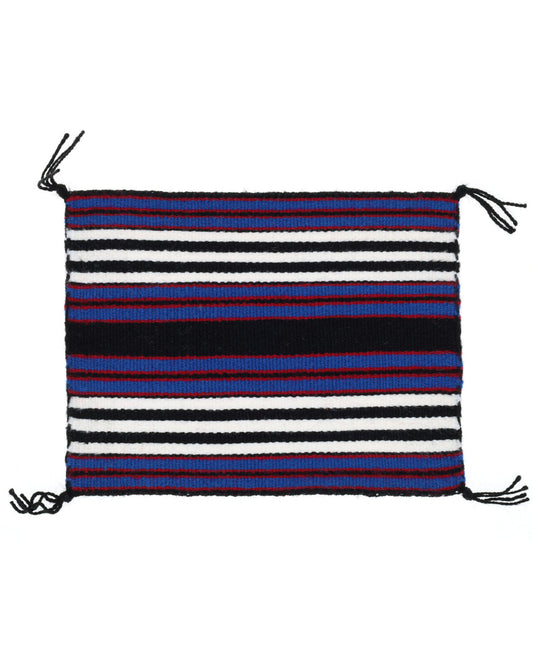
You don't need a living room floor to bring home a piece of Navajo weaving. Our handwoven Navajo rugs collection features miniature and tabletop pieces, each one woven by hand on a traditional loom rather than mass-produced. These weavings pair naturally with the jewelry SilverTQ has offered for decades, giving jewelry enthusiasts and first-time buyers another way to own a small piece of Native American artistic tradition.
Presently, the collection features work from Navajo weavers Matilda Yazzie Bia and Louise Yazzie, whose patterns reflect techniques passed down through generations. SilverTQ's reputation has been built on more than 45 years of relationships with Southwest artists, and that same hand-selected standard applies here.
Navajo Rug Patterns in This Collection
This collection spans nine distinct pattern types found in Navajo weaving.
- Two Grey Hills: undyed, natural wool in shades of gray, brown, black, and white, usually built around a bordered central diamond.
- Ganado: a deep red background with bold geometric patterns in black, white, and gray, named for the Arizona trading post town where the style was popularized.
- Wide Ruins: soft, vegetal-dyed colors arranged in banded, symmetrical designs rather than a central medallion.
- Storm Pattern: a middle block representing the center of the universe, connected by zigzag lines to four corner elements often read as lightning.
- Crystal: banded designs in muted, natural tones, named for the trading post near Crystal, New Mexico.
- Pine Springs: a regional variation known for fine weaving and understated color palettes.
- Shiprock: outline-style geometric borders, named for the rock formation in northwestern New Mexico.
- Yei Bi Chei: a pictorial style depicting stylized figures from Navajo ceremonial dances, distinct from the geometric patterns above.
- Chief blanket: one of the oldest Navajo textile forms, traditionally woven in bold horizontal bands and stripes.
Because each rug is a one-of-a-kind weaving, colors and exact dimensions vary somewhat from piece to piece, even within the same pattern family.
The Art and Technique of Navajo Weaving
Navajo weaving follows a process that has stayed largely the same for generations, whether the result is a miniature piece or a room-size rug.
Every rug in this collection begins on a traditional upright loom, the same tool Navajo weavers have used for generations. Wool is spun by hand, then dyed using natural or commercial dyes before it's woven thread by thread, without a printed pattern to follow. The weaver builds the design from memory and counts as they go, which is part of why no two rugs, even in the same pattern family, come out identical.
A single miniature rug can take anywhere from several days to several months to complete, depending on the pattern's complexity and the fineness of the weave. Full-size, room-size Navajo rugs take slightly longer but follow the same basic timeline, since the fine thread used in miniatures creates a weave count similar to that of large wool rugs. A weaver relies on the same loom and the same painstaking technique whether they’re working on a miniature wall hanging or a large floor rug.
Matilda Yazzie Bia, an award-winning Navajo weaver, is behind most of the pieces in this collection. Her work includes regional patterns such as Wide Ruins, Two Grey Hills, Storm Pattern, and Crystal, and it reflects the patience Navajo weaving has always demanded, regardless of a piece's size. The collection also includes occasional pieces from Louise Yazzie, another skilled Navajo weaver working in the Yei Bi Chei pictorial style.
Displaying and Caring for a Handwoven Navajo Rug
How you display and care for a Navajo weaving depends a lot on its size.
Because these are miniature and tabletop pieces rather than floor rugs, most customers display them differently than a standard area rug. A small stand or easel works well for a table, shelf, mantel, or bookcase, and displaying rugs directly on a wall, either alone or grouped with a few pieces from different pattern families, is a popular choice.
Direct sunlight will fade the wool's natural colors, so keep a rug out of a sun-facing window if you want the colors to stay vivid. Dust it occasionally with a soft brush or a low-suction vacuum attachment, and skip shaking or beating it, which can loosen the weave.
Why Buy Your Navajo Rug from SilverTQ
Many dealers sell Navajo weavings, but not all work directly with the artists who make them.
SilverTQ has spent more than 45 years building relationships with artists across the Navajo, Zuni, Hopi, and Kewa Pueblo jewelry communities, and that same standard applies to the rugs in this collection. Every piece is handmade by a Native American weaver, never mass-produced overseas.
Orders ship free within the U.S., and SilverTQ runs periodic sales that make it easier to add a handwoven rug to your collection without paying full gallery prices.
Frequently Asked Questions
What is the difference between a Navajo rug and a miniature Navajo rug?
A miniature Navajo rug is made on the same type of loom, using the same hand-weaving process as a full-size floor rug, with the same hand-spun wool. The only difference is scale, both of the thread and the finished piece. Miniatures are typically woven as wall hangings or small table and shelf pieces rather than floor coverings, making them a more accessible way to bring a handwoven Navajo textile into a home.
How can I tell if a Navajo rug is authentic?
Look for a continuous warp, the vertical foundation threads that run the length of the rug without being tucked in and cut off. Small, natural variations in the weave from row to row are a good sign too, since a mechanical reproduction of a Navajo rug pattern tends to look too uniform up close. Buying from a dealer who works directly with Navajo weavers is the most reliable way to be sure a rug is authentic.
How long does it take to weave a Navajo rug?
A Navajo rug can take anywhere from a few weeks to a few months, depending on the pattern and how fine the weave is. A miniature can take just as long, since the thinner thread means every additional row adds time without adding much surface area.
What do the patterns and colors in a Navajo rug mean?
Regional patterns like Two Grey Hills, Ganado, Wide Ruins, and Storm Pattern developed around specific trading posts and communities, and each has its own color palette and layout. Two Grey Hills relies on undyed, natural wool tones. Ganado is built around a red background. Wide Ruins favors soft, vegetal-dyed color bands instead of dyed contrast. Storm Pattern uses a central block connected to four corner elements by zigzag lines often read as lightning. The colors and shapes are tied to where a design was developed and to the weaver's individual style, more than to a fixed symbolic code.
How should I display a miniature Navajo rug?
Most customers hang a miniature Navajo rug on the wall, either as a single piece or grouped with a few others. A small stand or easel also works well if you'd rather display a piece on a table, shelf, mantel, or bookcase.
How do I care for a handwoven Navajo textile?
Keep the rug out of direct sunlight, since UV exposure fades wool dyes. Dust it occasionally with a soft brush or a low-suction vacuum attachment, and skip shaking or beating it, which can loosen the weave.
Are SilverTQ's Navajo rugs handmade by Navajo artists?
Yes. Every rug in this collection is handmade by a Navajo weaver. Federal law backs up that standard: the Indian Arts and Crafts Act makes it illegal to market a product as Native American-made when it isn't, with penalties for a first violation reaching up to $250,000 and five years in prison for an individual, or up to $1,000,000 for a business.