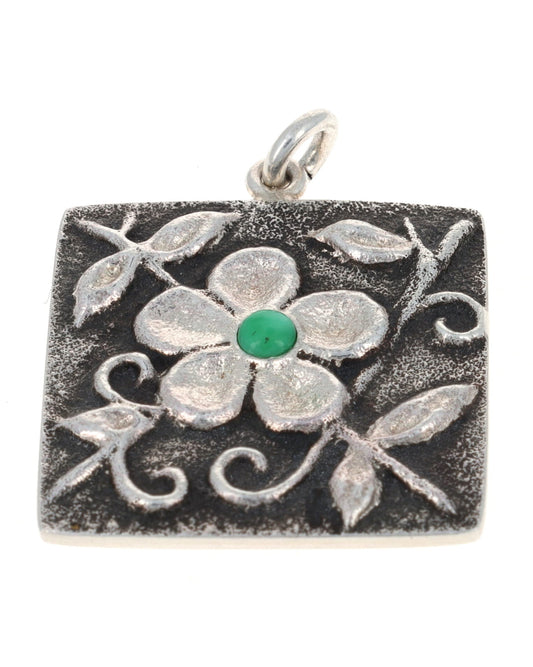
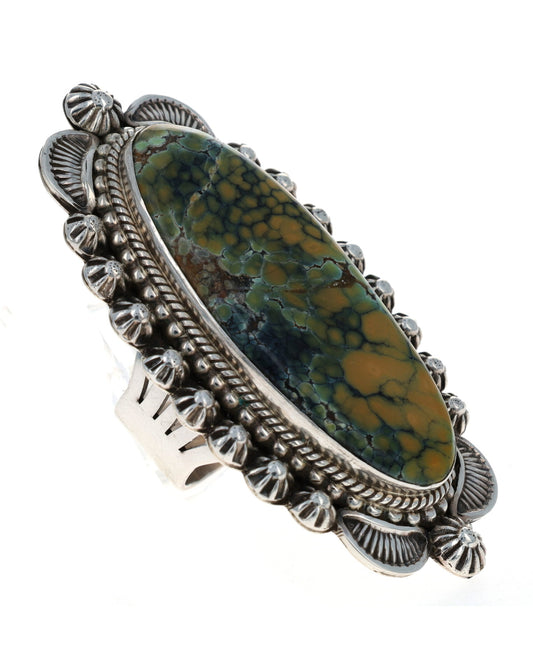
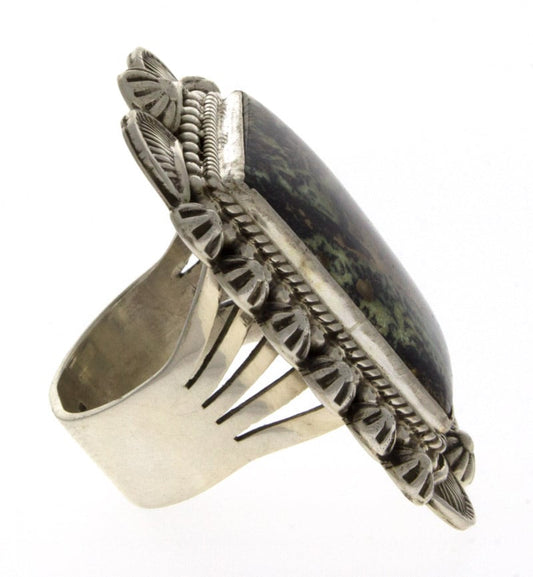
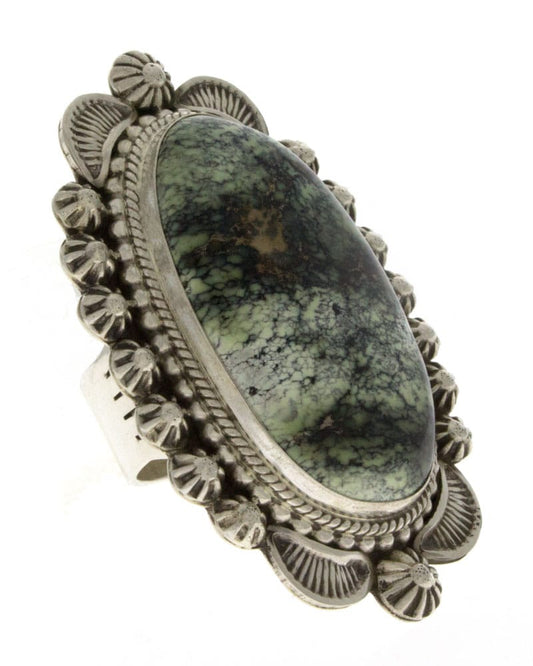
Damele turquoise ranks among the rarest stones to come out of Nevada. Pulled from a single small claim near Austin, the stone ranges from pale yellow-green to a rich lime, often webbed with a fine, dark spiderweb matrix. Because so little of it was ever mined, most of what circulates today comes from decades-old rough. This collection features Damele turquoise jewelry, including rings and pendants, hand-set in heavy-gauge sterling silver by respected Southwestern artists.
What Is Damele Turquoise
Damele turquoise takes its name from the Damele family ranch outside Austin, Nevada, where a rancher named Benny Damele found the deposit in the early 1970s. The stone belongs to a small group of Nevada turquoise varieties known less for volume than for color. You'll occasionally see it spelled Damale, Damali, or Demele on older jewelry tags and mineral labels, since the mine was never large enough for a single spelling to take hold across the trade. Whichever spelling turns up, it points back to the same claim and, usually, the same rare, high-contrast stone.
Where the Damele Mine Is Located
The mine sits on Dry Creek Ranch, a working ranch outside Austin, Nevada. Two other well-known claims, the Godber mine and the Carico Lake mine, lie in the same general stretch of high desert, and jewelry enthusiasts often compare stones from all three because their color families overlap. Damele's own claim is small next to those two, tucked into the foothills where the flats start giving way to pinyon and juniper.
Why Damele Turquoise Is So Rare
Large-scale digging at Damele never lasted long. Miner Clyde Wright worked the claim for close to two decades before it changed hands, and output had already slowed by the time he took over. Most Damele material sold today, turquoise included, comes from rough pulled from the ground years or even decades earlier. New rough rarely surfaces, which keeps supply tight and prices firm for finished jewelry.
The Look of Damele Turquoise
Damele turquoise looks different from most turquoise on the market, and color is usually the first thing people notice. Matrix pattern and shade both shift from stone to stone, which is why two pieces rarely look identical, even when they come from the same claim.
Color Range and Spiderweb Matrix
Color is what sets Damele apart from the blue turquoise most people picture first. Stones run from a soft yellow through olive and into a true lime green, with occasional shading toward gray. A dark, tight spiderweb matrix often runs through the stone, and the contrast between that dark webbing and the pale green background is a big part of what makes a well-matched piece stand out. Not every stone shows heavy webbing, either. Some Damele cabochons are nearly clean, which changes the look without changing the rarity.
Turquoise Versus Variscite and Faustite
The Damele claim also produces variscite and faustite alongside its turquoise. All three share a similar green-to-yellow palette, which is why people often confuse them when they see loose stones side by side. As a rule, variscite tends to look more glassy and translucent, while turquoise from the same ground usually has a slightly more matte finish. Turquoise is also the hardest, with a Mohs rating of 5 to 6, relative to variscite’s 3.5, and faustite sits somewhere between the two with a rating of 4.5 to 5.5. These are three genuine minerals pulled from one small patch of Nevada ground, and a jeweler working with rough from this claim can choose whichever one suits the piece at hand.
Damele Turquoise Jewelry at SilverTQ
SilverTQ typically carries Damele turquoise set in rings and pendants, with an occasional larger statement piece when the right stone comes through. Each one is handmade in heavy-gauge sterling silver, with the stone set by hand, which is part of why no two pieces look quite alike even when they share the same stone source. SilverTQ has spent more than 45 years building relationships across the Southwestern jewelry trade, and that history is the reason it’s possible to find rare Demele pieces listed throughout the site.
Sourcing and Selecting Each Piece
Because Damele material is scarce, pieces don't sit in a general queue waiting to be picked out of a catalog. SilverTQ's relationships with Southwestern artists mean every piece is selected straight from the jeweler's bench rather than a wholesale lot, and that hands-on approach is what keeps this collection curated. Any piece that makes it into the collection is chosen not only for its artistry, but for exceptional stone quality as well.
How to Style Damele Turquoise Jewelry
Damele's warm green tones read differently than classically blue turquoise against skin and clothing. That means the stone pairs naturally with earth tones such as olive and deep brown, while holding its own against black just as easily. Sterling silver keeps the look cool and echoes the stone's natural gray undertones, while a gold setting warms the green and pushes a piece more toward formal wear. A single Damele ring or pendant usually carries a look on its own, since the color and matrix already do most of the work.
Caring for Your Damele Turquoise Jewelry
Sterling silver develops a natural tarnish over time, and a standard silver polish is the simplest way to restore shine. All three stones connected to this claim are porous, so apply silver polish carefully and keep pieces away from lotion and most household chemicals, since contact can dull the color over months of exposure. Store Damele jewelry away from direct sunlight and extreme heat, and slip rings off before yardwork or other tasks that risk knocking the setting against a hard surface.
Frequently Asked Questions
Is Damele turquoise rare?
Yes. The claim near Austin, Nevada, was never large, and active mining stopped decades ago. Most Damele turquoise sold today, whether set in jewelry or sold as loose stone, comes from rough that was pulled from the ground years earlier, which keeps new supply extremely limited.
What is the difference between Damele turquoise and Damele variscite?
Turquoise and variscite both come from the same claim, but they’re different minerals. Variscite usually looks more translucent and glassy, while turquoise tends to show a slightly more matte finish. A jeweler working with rough from this claim decides which stone suits a given piece, and the color range across all three often overlaps.
How does SilverTQ source and select its Damele turquoise jewelry?
SilverTQ has spent more than 45 years building direct relationships with Southwestern jewelry artists, and Damele pieces come through those relationships. Given how little Damele material exists, each piece is chosen individually, based on the stone's color and matrix along with the artist's technique.
Where does Damele turquoise come from?
It comes from a single claim on Dry Creek Ranch outside Austin, Nevada, in the same general area as the Godber and Carico Lake mines. Benny Damele discovered the deposit in the early 1970s, and it has been mined on and off on a small scale since then.
How should I clean and store Damele turquoise jewelry?
Clean the sterling silver with a standard silver polish, and leave the stone alone since it is porous and can absorb chemicals. Store pieces away from direct sunlight and heat, and slip rings off before yardwork or anything else that risks knocking the setting against a hard surface.